The CardSpace dimensions

Axel Nennker from T-Systems in Germany now has a blog called ignisvulpis (OK, no translation found in search engines – I had to crack open my latin dictionary to be reminded that ignis means ‘fire’ and vulpes means ‘fox’…   Yikes, Axel!)  Axel is a contributor to the openinfocard project started by Chuck Mortimore and Ian Brown.

In a bizarre case of Information Card Fever sweeping through Germany, he writes:

Yesterday I learned that the team of the new java CardSpace project jinformationcard works in the same building as I do. As I am a contributor to the openinfocard project we now have two independent java CardSpace projects “in the house”. 

That's amazing.

Anyway, I heard Axel speak at a meeting a while ago and was fascinated by the way he conceptualized his “information card dimensions”.   Now I can share it with you because he posted it to his blog:

While thinking about how Windows CardSpace could be used and extended I came up with this graphic.

Thus the dimensions of Windows CardSpace are:

  1. Cardstore: Where is the cardstore?
    Service Providers store the information cards and facilitate the use through different devices.
  2. CredentialStore: Where are the credentials?
    Storage of credentials and engine for cryptographic operations.
  3. UI Generation: Where is the UI generated?
    The UI could be generated on a server but be displayed on one of the user’s devices.
  4. Identity Selector (UI): Where is the UI displayed and where is the Information Card selected?
  5. STS: Where is the STS?
  6. STS Authentication: Authentication Technology
  7. Browser: On which device is the authentication needed?

Now imagine all the combinations of the coordinates which span “use case space”.  My colleague Jochen Klaffer designed and implemented a tool which helped us a lot to find relevant use cases in our “CardSpace for Telcos” project which we are doing for Deutsche Telekom Laboratories’ Jörg Heuer.

This is of course only a selection of possible dimensions.  Others were excluded for simplicity and because there are strong indications that they will never be relevant.  Kim Cameron said e.g. about using different protocols instead of WS-*: “This will not happen”.

So the “Trust Protocol” dimension is not shown in this graphic.

Other dimensions missing are new transport protocols like SIP instead of HTTP to transport the RST/RSTR. So the “Transport Protocol” dimension is not shown in this graphic.

You will probably notice that there are points on the axis that are not part of CardSpace version 1.0…

Let us look at CardSpace 1.0.

  1. Cardstore: local (secure desktop).
  2. CredentialStore: local (secure desktop).
  3. UI Generation: local (secure desktop).
  4. Identity Selector (UI): local (secure desktop)
  5. STS: local or network
  6. STS Authentication: fixed set of four technologies
  7. Browser: PC

So this the current state, but the universe is expanding, right?

Interpretation of the axes and the new points the axes is left to the reader 😉

I think this is really brilliant and have been amazed at the methodologies being used.  I hope Axel will also report on the work by Jochen Klaffer to which he refers.

One small correction – we already support a simple RESTful http post of a token to a relying party – in other words, no need for WS.  So there is a protocol dimension.  In terms of the highly trusted connection between identity selector and identity provider, I would much rather avoid introducing alternate protocols that would drastically increase our attack surface and test matrix.

Ensuring Privacy and Consent

I think many will benefit from Marco Casassa Mont's Research on Identity Management blog.  He discusses business-driven identity management – and its foibles.

A recent post invites us to an upcoming Kable conference that I would attend if I possibly could:

An interesting conference is going to take place on July, 9th in London, UK on “Ensuring Privacy and Consent in Identity Management Infrastructures”. It is supported by DTI and free to attend to the private sector and academics. The conference program and online registration form are available here.

“The Department of Trade and Industry (DTI), through the Technology Strategy Board's Network Security Innovation Platform, is working with the Identity and Passport Service (IPS), the Home Office, the Economic and Social Research Council (ESRC) and the Engineering and Physical Sciences Research Council (EPSRC) to develop a work package that will sponsor a £10m, 3-year, research and development programme into how to balance the potentially intrusive nature of identity services and network security with users’ expectations of privacy and consent. This research will be cross-disciplinary, combining social science with technological innovation. …

The aim of this initial workshop on 9 July is to discuss and refine the areas of importance for research, as well as identifying where the research is needed and where the UK has potential to develop world-leading commercial services. The findings of the workshop will lead to the development of projects and proposals using the EPSRC's sand-pit concept at a further workshop to be held in early October.”

You might want to consider attending if you work in the areas of identity and privacy management …

Paul Madsen leaks internal photo

Despite my repeated requests not to go there, Paul Madsen of ConnectID has published a leaked, top secret, internal Microsoft Identity and Access photo.  His post reads as follows:

An un-named source in Redmond sent me this never before seen picture of the first ever infocards assembly line.


In the front you can see a worker inserting secret keys obtained from the bins below (the punch-card calculating machines on which those keys were generated are in another room). Other workers further down the line can be seen inserting attributes before securing the top of the cards with wrenches.

My source tells me that another line is planned.

Luckily, the IP revealed by this photo is part of the Open Specification Promise (OSP).  I checked with our operations people to see if the items in the bin  really are the secret keys, but apparently they are silver bullets.

PHP managed card provider

Here's a new managed card provider from Patrick Patterson at  Carillon Information Security Inc.  With commendable understatement, Patrick writes:


I just thought that you'd like to know about a demonstration STS for issuing managed infocards that we've just finished.It's written in PHP, backends into either a database or LDAP, and is easily customizable to accommodate custom claims.

And, since it is written in PHP, it is easily deployable for those that want to experiment with a CardSpace STS, but who may not have either a JSP server to deploy one of the other Java based implementations, or an IIS .NET server to experiment with the one Microsoft has provided.

It is available here.

I'm a sucker for PHP and Ruby on Rails, so I love seeing this support.  Beyond that, I'm interested in Carillon's support for certificates. 

What is it?

The Carillon STS is a PHP-based Federated Identity Provider (IdP) which is capable of acting as a Secure Token Service (STS) compatible with Windows CardSpace and other “infocard” implementations. It has been successfully tested with CardSpace, as well as with Chuck Mortimore's Firefox identity selector plugin.

Once installed and configured, the Carillon STS allows a user to authenticate himself, either by password or by X.509 certificate, whereupon he is issued a digitally signed infocard containing some standard identity claims and optionally some customizable identity claims. When he presents this infocard to a Relying Party's (RP's) site, his browser's identity selector requests a SAML token from the Carillon STS. If the authentication information is still valid, a digitally signed token will be issued with the various claims asserted. The browser takes this token, checks the digital signature, encrypts it for the RP, and passes it along. It is the RP's responsibility to decrypt the SAML token, check the digital signature, check the asserted claims, and make an access decision based on this information.

Current Status:

This project has been tested with available releases of Windows CardSpace and the Firefox identity selector plugin. There are several Relying Party (RP) sites on the web to test against; in particular, the xmldap.org RP is able to consume Carillon STS infocards and display their contents.

Version 0.01 is the initial release of the Carillon STS. It is presently under active development.

License:

The Carillon Demo STS is free software; you can redistribute it and/or modify it under the terms of the GNU General Public License as published by the Free Software Foundation; either version 2 of the License, or (at your option) any later version.

This program is distributed in the hope that it will be useful, but WITHOUT ANY WARRANTY; without even the implied warranty of MERCHANTABILITY or FITNESS FOR A PARTICULAR PURPOSE. See the GNU General Public License for more details.

Carillon Demo STS is Copyright © 2007 Carillon Information Security Inc.

Download:

Note: Please hold down the SHIFT key while clicking on package you want to download to avoid file corruption.

Source: carillon-sts-0.01.tar.gz

I hope to meet Carillon at the next Interopathon.  It's really awe-inspiring to see this level of Information Card expertise developing spontaneously in the security and identity communities.  Congratulations, folks!

CardSpace and Smart Cards

Over the next few days I will write about some of the Information Card ideas and products I saw at the Burton Group's Catalyst Conference.  The Interopathon demonstrated a whole slew of identity provider, identity selector and relying party products written by all kinds of competitors and collaborators.  Pretty much all the big software companies were involved, as were a some smart identity industry startups.  The next day, the party continued in the Microsoft hospitality suite – and probably other suites as well.

One of my favorite demonstrations was put together by Gemalto, one of the world's largest manufacturers of smart cards, cell phone SIMS and dongles.  They collaborated closely with the CardSpace team on a prototype of CardSpace in which Information Cards and the associated metadata and secret keys are all kept on a smartcard or dongle.

Here's the user experience:

You arrive at a machine, and insert your smart card. 

CardSpace asks for a password, and when you enter it, you see your CardSpace cards as usual – except they marterialize from the smart card.  The system supports both self-issued and managed cards. 

Then, when you remove your smart card, all the CardSpace cards go away.

In other words, the system completely solves the roaming and “kiosk” problem.  You take your Information Cards with you, and use them wherever you go.  A single smart card can transport a whole set of unrelated cards – the “Fist full of dongles” problem is solved.

The Gemalto folks have a demo that makes the ideas completely clear here.   Much of the work was done by Kapil – great guy  and I have my fingers crossed that he'll start blogging again.

Including the whole spectrum of use cases

Mathew Martin, who writes Mostly Mr. SQL, clearly detests PKI certificates more than almost any living person.  He finds CardSpace guilty by association in a piece called GRRRR!  CardSpace.  What a useless steeming pile…

Ok. Cardspace/Infocard is like OpenId.  Password-less access to websites (or password-fewer access).

BUT

1. You must use SSL.  Even if you just want to secure your application against your clueless neighbor.  That is a minimum of $40.

2. You must decrypt the response on an account with NTFS access to the private key.  The NT Network Service account is not likely to have read access to the private key on a hosted account.  Good luck explain how and getting co-operation from your hosting provider.

3. Decryption must be done under FULL TRUST.  Many hosted accounts only let you run in medium trust and don’t let you create COM+ dlls, put stuff in the GAC, etc.

[Items 2 and 3 might not even be a good idea.  If the world at large manages to use your web application to maliciously download your SSL cert, I suppose they could do something evil, like pretend they are you]

4. To get rid of the “the website isn’t secure for banking or ecommerce” you have to spend $1000 on an EV SLL cert.  Oh, sure, pocket change.

5. And who is issuing managed cards? I can get an SSL based cert from Thawte that says I am the person that controls my email account, but I can’t find anyone who issues managed infocards anywhere.

I’ve about realize that I–a computer profession and programmer, will not be able to implement InfoCard/Cardspace in any form, not for my blog, not for my hobby website, nothing.  Either one has $1040 and ones own entire server or nothing.

If only the top 10 biggest websites can overcome the hurdles posed by infocard, what we are going to see is 5 websites accept infocard and everyone else (mom & pop websites) continue to use passwords and user ID’s. InfoCard will have a minimal impact on how authentication is done.

This is going to drive small websites into using OpenId.  Consumer will rapidly gain a few dozen OpenId cards.  The rising ubiquity of OpenId–which doesn’t try to be a waterproof authentication method–will take over the world, relegating InfoCard to “that way you logon to Live.com services”.

Come on Microsoft, when are we going to be able to run CardSpace/Info card in “real world” mode?

[Thanks to Self-issued.info for the logo]  [Actually, I take that back, it is a Microsoft trademark. The purple box is has a substantial amount of IP self legislation that goes with it.  According to MS’s lawyers, I am currently in violation of usage guide lines for the icon.  Let’s see how Microsoft silences critics of InfoCard.]

Let's start with the CardSpace requirement that a relying party support SSL.  I agree with Mathew that requiring use of SSL and PKI is overkill for the type of blogging and hobbyist use cases he describes.  While my identityblog certificate is fairly inexpensive (thanks to godaddy.com), the extra cost associated with it at textdrive (which hosts my system) is around $100.00 per year because of the need to have a dedicated outward facing IP address.  I don't mind the cost too much, since I know there are people who will hit on my site and I like the extra protection.  But this really isn't appropriate for everyone. 

This underlines the fact that identity and the identity metasystem involve a continuum of use cases and technologies – and we have to embrace the whole continuum.  By making certificates mandatory, we cut the continuum in half.  Luckily, we can fix that before we get into the wide deployment phase.

My conclusion is that rather than hard-wiring the requirements for identification of a relying party into the identity selector, we should have allowed each identity provider to decide what minimal requirements were appropriate. 

This ends up having advantages both at the low value and high value ends of the spectrum. 

For example, a bank's IP might decide to only release information to a relying party with an Extended Validation (EV) certificate.  If so, CardSpace would not illuminate the associated information card if an EV certificate were not in use at the relying party site.   [EV certificates are only granted to companies or other organizations after they follow an extensive procedure for proving their legitimacy.]

Meanwhile, a blogging reputation identity provider might be happy to release reputation to any site the user proposes, certificate or no certificate.

Of course, the relying party is always free to use a certificate and gain the extra protection that provides.

This change is actually part of CardSpace 1.1 – which people should be able to start experimenting with very soon now.  When combined with the release of great toolkits for all the important languages, I think this will bring quite a bit of lift-off.

As for point 4), let's look at what the CardSpace advisory actually says:

I think there's a big difference between “a major internet business” and a site doing “ecommerce”.  When I buy a tee-shirt from Mathew I don't expect him to be EV.  If he were trying to sell thousand dollar cameras, I would feel differently.  I'd want him to either be well identified, or to work through a site like eBay that would provide another way of establishing his reputation.  And in this case, I want to make sure I'm really talking to eBay, so once again would like to see an EV cert.

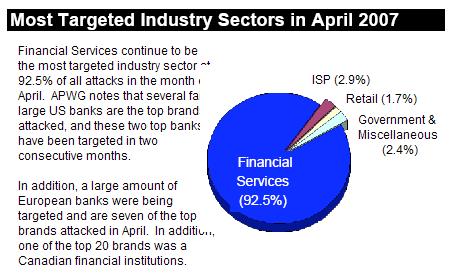
I don't think any “major internet business” or bank will have any difficulty whatsoever covering the cost of an EV cert.  The idea of using the superior certs came directly from them, since they're the ones whose users get phished.  I don't understand why, given his earlier rant against the poor validation proceedures in conventional certificates, Mathew rails against our support for EV.  Part of his earlier criticism of EV certs is that the browser doesn't show the meaning of the cert properly, a problem CardSpace has solved. Consider this recent Anti-Phishing Working Group report:
As for who is issuing managed cards, you'll be seeing many outfits doing it as we move toward the InfoCard tipping point.  We're in the sockets and ecosystem phase of Information Cards, but I can tell you many players get the potential of the technology and are integrating it into product.

As for OpenID versus Information Cards, I don't see them as opposites.  Go to signon.com today and you'll see it supports use of Information Cards for OpenID authentication.   This is nice because it gets you InfoCard safety along with OpenID long-tail support. Going forward, I think you'll see most OpenID vendors supporting OpenID managed cards that work with OpenID sites.

As for the Information Card Icon, our intention is that it be available to everyone who supports the technology.  There has been pushback on the language around the icon, and we'll be figuring out how we can get this thing right.  In the meantime, I wouldn't be worried about using it on a teeshirt or to criticise us – but I would be worried about using it at a phishing site. 
Catalyst Interopathon reveals sea change

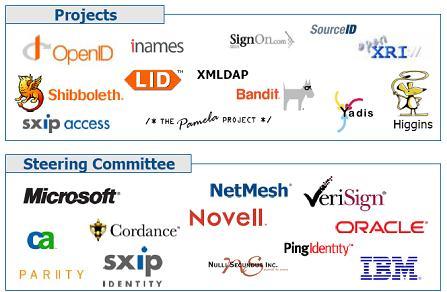
Here are the logos of the projects participating in the Information Card Interopathon at the Burton Group's Catalyst Conference. Beyond that, people told me about at least half a dozen new open source projects (each with a unique mission) that are sitting in the wings getting ready to go public.  I'll try to keep you posted on these. 

We had a rehearsal for this a couple of months ago at Internet Identity Workshop, but something has changed since then:  many of the players seem to have made strides in getting concrete about how the technology would be used in their products.  That's the key.

According to the press release:

Participants include projects groups Eclipse Higgins Project, Internet2 Shibboleth Project, The Pamela Project, Ian Brown (OpenInfoCard), XMLDAP, and SocialPhysics and vendors BMC Software, CA, FuGen Solutions, IBM, Microsoft, NetMesh, Novell, Nulli Secundus, Oracle, Ping Identity, Sxip Identity, VeriSign, and WSO2.

The demonstration will be centered on a photo sharing application and will show the breadth and maturity of user-centric technologies by executing a variety of information card-based component capabilities including:

  • Protocol and wire format interoperability
  • Card format interoperability
  • Policy interoperability
  • Platform interoperability 

The interop event was organized by OSIS and identity commons and hosted by The Burton Group.  Thanks to all involved.

Dave's mother

During one of the hospitality parties at the Burton Group's Catalyst conference I came across the SXIP folks showing their cool new application service “outsourcing appliance” that lets enterprises outsource HR or mail and calendar to companies like Salesforce.com and Google.  When employees are inside the firewall, they can just leverage Active Directory or some other LDAP server or authentication system to automatically create a SAML token that will log them into the service.

One of the requirements SXIP has encountered is for employees to be able to securely access these resources from their homes and hotel rooms without introducing the risk of password leaking. 

After all, most companies don't want employees revealing their enterprise username and password to service suppliers – but also don't want to support a separate username/password outside the firewall…  SXIP's solution:  use Information Cards.  It's a very simple and nice solution.

While looking at what they've done, I met David Huska, the incredibly fast and energetic engineering guy behind the project.  He started telling me about CardSpace and his mother, and I could see he had a great potential CardSpace “elevator pitch” – meaning a way to explain a technology while riding an elevator up a few stories.  So I cut him off, pulled out my phone, and asked him to start again.  Here's what he said:   
Kim:  So you were talking about your mother…

Dave:  What were you saying about my mother, Kim?  Were you talking about my mother?

Kim:  I love your mother.

Dave: Alright.  CardSpace is an analogy my mother gets.  She doesn't understand what I do in a million years, but CardSpace she gets.  She sees the cards.  Everything else stops.  Everything goes away.    She can't do anything else until she chooses a card. 

When she pulls our her purse, she sees her cards.  And with CardSpace, she sees her cards.  She can see what card they want from her.  She can see the information they're looking for from her.  She can decide what she wants to use, or not – what she wants to approve or not. 

It's like being in the supermarket.  She can decide which card she wants to give – and if she wants to.  It makes sense for her.  It's simple.  Its a clean UI.  It's well done. 

Kim:  (Referring to SXIP's cool new system – that supports Information Cards.)  So has your mother actually seen this?

Dave:  Yes, she's seen it running on my test machine.  She said, “Oh this is what you do.  I finally get it.”  And I had to say, “Well, this isn't exactly what I do – it's what another company does.”  But you got her closer to understanding what I do than just about anything else I've ever shown her.  So thank you.

Dave is great – and I love his mother too.  Any thanks should be directed to all the people on the CardSpace team who did all the work and refinement and threat modelling and studies, and who are coming out with a nice update in the very near future.

Trustworthy Computing Privacy Award

While working on the Laws of Identity and CardSpace, it seemed that each new idea led inevitably to the next.  I really had no choice in arriving at the concepts that arose.  There was no other way to create an identity layer for the internet.   

But as the issues unfolded, it became clear that the road to be travelled wasn't going to be easy.  In fact, it was going to be hard.  It involved risk.  It required people and organizations to rise to challenges that seemed almost impossible.  It needed profound goodwill.  Do we dare say it required trust?

In the early days, as I shared my conclusions, my colleagues in the blogosphere and the conference rooms would say, “Kim, we don't doubt your personal integrity, or your vision; but surely you can't expect us to believe that Microsoft is really going to back you on this stuff…”

And when I looked coldly at what would be required of Microsoft, I could see that there was probably no large company in the world that could do all the counter-intuitive things necessary for success. 

  • In a world where the erosion of privacy was becoming endemic, I would need a Microsoft relentless in championing privacy. 
  • In a world where you are normally lucky just to get your research funded, I would need a Microsoft that would not only fund but then freely share every aspect of the new technology. 
  • In a world polarized between open-source and inventor-owned software, I would have to ask both sides to work together in a single community for the good of everyone. 
  • Having concluded that the original thinking about Passport broke the laws of identity, I would need a Microsoft willing to admit to the mistake, and show it could learn from it. 
  • Above all, I would need a Microsoft that would let me be completely open about what I was thinking, despite my internal role as an architect.  That was the only way I could speak both to Microsoft and to the rest of the industry, to argue for the changes everyone would need make if we were to be successful. 

The project could not succeed if we failed to achieve any of these.  And then, only after that, you had all the uncertainty associated with the introduction of any new paradigm, and any new product.  I would need a team willing to buy fully into all the architectural tenets, and to defend them with passion while building something eminently usable.

Other than love, there is little that is higher in my estimation than authenticity.  To actually be the architect of identity I was supposed to be, I would have to express what was required, try to find the language, try to build the context.   That's what this blog has been about, transforming itself so that more and more it became a place for me to learn and to work.  

If this has all been a voyage, this week was a milestone.  The interoperability event at the Burton Group's Catalyst conference was stunning (more later).  The combined impact of the open source community and Microsoft and many other companies charging into this new world of Information Cards and claims-based computing was intoxicating.   

But there was a second milestone as well – one which I had never predicted.  And although it seems like a personal one, it really isn't, so I hope you will let me share it with you.

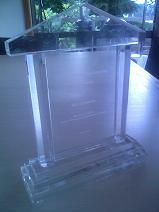
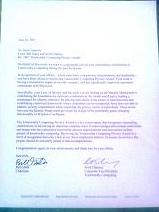
I received an award from my colleagues at Microsoft.  Here's the congratulatory letter:

To: Kim Cameron
From:  Bill Gates and Scott Charney
Re: 2007 Trustworthy Computing Privacy Award

On behalf of Microsoft, we want to congratulate you for your outstanding contributions to Trustworthy Computing during the last year.

In recognition of your efforts – which stem from your passion, determination and leadership – you have been chosen to receive the Trustworthy Computing Privacy Award.  Your work is having a tremendous impact across the company, and has significantly improved customers’ interactions with Microsoft.

Specifically, your Laws of Identity, and the work you are leading on the Identity Metasystem, is establishing the foundation for electronic credentials in the virtual world, and is leading a renaissance for identity solutions.  By placing individuals at the center of trust decisions and establishing contextual frameworks where credentials can be recognized, these laws are able to address security requirements while respecting the privacy needs of individuals.  These seven laws, and the identity metasystem, governed the design of the potentially game-changing functionality of Windows CardSpace.
The Trustworthy Computing Privacy Award is a key achievement that recognizes outstanding contributions in advancing an important company tenet. It acknowledges and rewards individuals and teams who have pioneered noteworthy process improvements and innovations in their pursuit of trustworthy computing.  Receiving the Trustworthy Computing Privacy Award is a level of recognition that only few of our finest employees achieve.  Everyone involved in this project should be extremely proud of this accomplishment.

Congratulations again on your achievement, and congratulations on your efforts.

Sincerely

Bill Gates, Chairman, and

Scott Charney, Corporate Vice President, Trustworthy Computing.

Not only had Microsoft supported my work.  It had risen to the extreme challenges my work set for it.  And this would not have been possible without the contribution of many others, like Scott Charney, who were working to guide Microsoft in the same direction I was. 

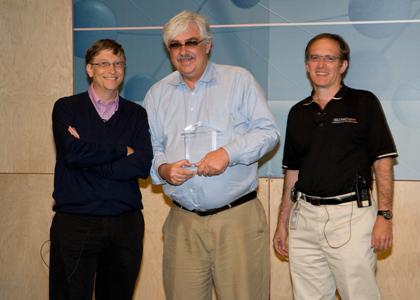
I was especially happy to receive the award from Bill Gates, whose vision reaches across every aspect of technology.  He, above anyone else, is the symbol of a Microsoft that “gets” identity, and I thank him very deeply.

I don't normally get into a lot of stuff about Microsoft on the blog, but this award thing has made me stop and think about what she has been willing to do, OSP and all.  I congratulate her on what she has done already, and will continue to do, to move us closer to the identity big bang.

Control, not nagging

In a piece called Pleading down the Charges, Jeff Bohren of talkBMC  refers to the discussion I've had with Conor about invisible redirection as ‘inflammatory’, and adds: 

“In subsequent exchanges Kim and Conor plead the charges down from a felony to a misdemeanor. Kim allows that the redirection is OK so long as the IdP is completely trusted, but he is concerned about the case where the IdP is not trustworthy…

It's probably true that my “hand in wallet” metaphor was a bit stark.  But how can I put this?  I'm doing a threat analysis.  Saying everything is OK because people are trustworthy really doesn't get us very far.  Even a trustworthy IdP can be attacked;  threats remain real even in the light of mitigations. 

When we put on our security hats, and look at the security of a system, we try as hard as we can to explore every possible thing that can go wrong, and develop a complete profile of the attack vectors.  No one says, “Hey, don't talk about that attack, because we've done this or that to prevent it.”  Instead, we list the attack, we list what we do to mitigate it, and we understand the vulnerability.  We need to do the same thing around the privacy attack vectors.  It is revealing that this doesn't seem to be our instinct at this point in time, and reminds me of the days, before the widespread vulnerability of computer systems became apparent, when people who brought up potential security vulnerabilities were sent to stand in the corner.

Jeff continues:

What is missing from this discussion is the point that “automatic redirection” is not mandated by SAML. Redirection, yes, but automatic redirection is not required. The SP could very well have presented at page to the user that says:

“Your browser is about to be redirected www.youridp.com for the purposes of establishing your identity. If you consent to this redirection, press Continue. If you do not consent, press Cancel….

Correct.  This could be done.  But information can also be made to fly around with zero visibility to the user.  And that represents a risk.

Jeff concludes:

Nobody does this kind of warning because the average user doesn’t want to be bothered and isn’t concerned with it. Not as concerned as, for instance, having a stranger reach into their pocket.

Actually, thanks to “invisible system design”, the “average user” has no idea about how her personal information is being sent around, or that with redirection protocols, her own browser is the covert channel for sharing her identity information between sites.  This might be all right inside an enterprise, when there is an implicit understanding that the enterprise shares all kinds of personal information.  It might even be OK in a portal, where I go to a financial institution and expect it to share my information with its various departments and subsidiaries.  But in the age of identity theft, I'm not so sure she would not be concerned with the invisible exchange of identity information between contextually unrelated sites.  I think she would probably feel like a stranger were reaching into her wallet. 

To be clear, my initial thinking about the “hand in wallet” came not from SAML, but from X.509, where the certificates described in Beyond maximal disclosure tokens are routinely and automatically released to any site that asks for them without any user approval.  SAML can be better in this regard, since the IP is able to judge the identity of the RP before releasing anything to it.  In this sense, not just any hand can reach into your wallet – just a hand approved by the “card issuer”…  This is better for sure.

Do we need to nag users as Jeff suggests might be the alternative? No.  Give the user a smart client, as is the case with CardSpace or Higgins, and whole new user experiences are possible that are “post nagging”.  The invisibility threat is substantially reduced.

In my next post in this series I'm going to start looking at CardSpace and linkability.