InfoCards for Firefox users

From Chuck Mortimore at xmldap.org

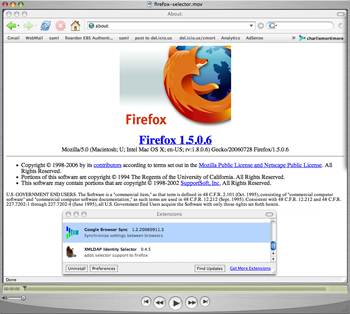
It sounds like Craig Burton has been having trouble with the demo Cardspace Selector I put together for Firefox. I'm not sure what trouble he's been having, but I thought I'd toss up some quick instructions, and a screen cast.

Step 1) Make sure you're on Firefox 1.5 or greater.

Step 2) Make sure you've got J2SE 1.4x installed on your machine. The xmldap selector doesn't use any .net or Microsoft code…its a cross platform implementation written from scratch in Java. You can hit http://java.sun.com if you need to download a JDK

Step 3) Go to http://xmldap.org and download the Firefox extension. You may need to allow the popup blocker to trust my site. Restart firefox.

Step 4) Go to a Cardspace enabled site like xmldap, identityblog, or ping

Step 5) Click to login, create a card, and submit.

Note that you'll still get a warning saying: “Additional plugins are required to display all the media on this page” Ignore it…I haven't figured out how to make it go away yet. Please email me or comment if you know!

Craig and others – email me at cmort at xmldap.org if you have questions or issues!

When I tried it I was using an earlier version of Firefox and had no luck – so make sure you get onto Firefox 1.5 or later.

By the way, this is a must-see demo not only for its general coolness, but for the special coolness of its sound track.  It's really a wonderful, no-nonsense piece of work.

Pretexting and Privacy

I've never seen Craig Burton write about privacy before.  Clearly he's had enough of the recent goings-on: 

  1. I was listening to Talk of the Nation on National Public Radio this afternoon. There was a good discussion going on sparked by the fiasco that happened at HP the last few weeks. Since I cover lexicon, identity, and security, I thought it would be a good idea to cover some of the conversation.
  2. What has emerged new to the general conversation is the term “pretexting”. This is the practice that investigators–both private and internal–use to pretend that they are someone else to obtain personal information from service companies. This includes, the phone company, cell phone companies, banks, utilities, county ownership records, and other private and public agencies.
  3. This is not a new term, but one that is getting public recognition as a result of the HP fiasco.
  4. According to the conversation that I heard, there is a synonymous term in the hacker community for pretexting called “social engineering.” There are some states that have made pretexting and social engineering illegal. California, Tennessee and Florida are exceptions maybe. This is a gray area and is only coming to light after these events.
  5. The previous hacker turned consultant in the conversation is the author of the book The Art of Deception.
  6. Here is my take on this. The government and agencies are not going to be able to cope with this problem. This means that it is your responsibility to protect yourself. There are a few major areas that you can focus on that will help you.
  7. Use InfoCards for login when you can. I admit this is new stuff, but it is fundamental in protecting your information from phishing and hijacking. InfoCard technology will change the future of hackers and thieves. You can support this by understanding it and using it.
  8. Stop using common methods of identification. Your social security number, you mother's maiden name and your birth place are redily accessible to social engineering agents.
  9. Use encryption for your data and emails. There are several technologies that will help you with this. You can do it at work and for your personal emails where needed. Without encryption, you have to assume that your emails are totally accessible to anyone who wants them. The current email technology is hackable and in clear text that is readable by anyone.
  10. You have to assume that at work, there are people keeping track of what you do with your computer. This is an issue, but you can also understand that your employer probably doesn't have the resources to look that closely at what you do.
  11. However, they also had a guy on the program that was being offered a job–a high profile and high paying job–that was revoked after the person had some email conversations about the terms of employment with his attorney. The company actually monitored his email conversations and gave him the choice of resigning or being fired as a result of the interchange. Scary.

Ms. Dunn at HP has struck a deal with the HP board to resign as a result of the press and fiasco. Did she know what the legal dept. was doing? Probably not. My opinion is that she should have found out on an issue of this importance at that she should probably step down now and not later.

I appreciate his comment about the role of Cardspace. 

And while we're talking about Craig, Has everyone seen his recent Poser sculpture entitled, “If I just give this Web 2.0 bubble a flick, nobody will get hurt, right?“:

A take on Microsoft, OSP and Open Source

Here is how Martin LaMonica from CNET interpets the Open Specification Promise:

The software giant on Tuesday published the Microsoft Open Specification Promise, a document that says that Microsoft will not sue anyone who creates software based on Web services technology, a set of standardized communication protocols designed by Microsoft and other vendors.

What's new…
Microsoft has promised not to sue anyone who creates software based on Web services technology covered by patents it owns.

Bottom Line
The move reflects how Microsoft has had to come to terms with open-source products and development models.

Reaction to the surprise news was favorable, even from some of Microsoft's rivals.

“The best thing about this is the fundamental mind shift at Microsoft. A couple of years ago, this would have been unthinkable. Now it is real. This is really a major change in the way Microsoft deals with the open-source community,” said Gerald Beuchelt, a Web services architect working in the Business Alliances Group in Sun Microsystems’ chief technologist's office.

Microsoft has never sued anyone for patent infringement related to Web services. But its pledge not to assert the patents alleviates lingering concerns among developers who feared potential legal action if they incorporate Web services into their code, said analysts and software company executives.

Open-source developers, for example, should have fewer worries about writing open-source Web services products. Also, other software companies could create non-Windows products that interoperate with Microsoft code via Web services.

The move reflects how Microsoft has had to come to terms with open-source products and development models.

When Linux began to take hold in the late 1990s, company executives seemed shaken by the shared code foundations of the open-source model. CEO Steve Ballmer famously called Linux a “cancer,” while founder Bill Gates derided the “Pacman-like” nature of open-source licensing models.

Other Microsoft executives, such as Windows development leader Jim Allchin, have in years past painted open source as “an intellectual property destroyer.”

But in the past two years, Microsoft has stepped up its Shared Source program, in which it gives free access to source code under terms similar to those in popular open-source licenses. It has also said it will make Windows-based products work better with those from other vendors, including Linux and other open-source software.

Standards in play
To be sure, Microsoft, which spends more than $6 billion a year on research and development, remains committed to generating proprietary intellectual property. In some cases, that means commercial licensing, rather than opening up access to others.

“In the future, I am sure we will take positions on IP (intellectual property) that will not be so agreeable to various constituencies,” wrote Jason Matusow, Microsoft's director of standards affairs, in his blog.

In the case of Web services, having a pledge not to assert patents around these protocols–which are the communications foundation of Vista, the next version of Windows due early next year–helps drive adoption of those standards in the marketplace, said analysts and software company executives.

Open-source projects, in particular, have become powerful forces within the industry for establishing standards, both de facto and those sanctioned by standards bodies.

“I expect that more and more vendors will realize that a software standard cannot be successful if the relevant patents are incompatible with open-source licenses and principles,” said Cliff Schmidt, vice president of legal affairs at the Apache Software Foundation, which hosts several open-source projects.

Patent pledges of various forms have become more common, he noted. Sun recently said that it would not assert patents relating to the SAML (Security Assertion Markup Language) standard and the OpenDocument Format. IBM gave open-source communities access to 500 patents last year.

More to come?
Microsoft's Matusow said that the Open Specification Promise is part of the company's efforts to “think creatively about intellectual property.”

For the Open Specification Promise, the company sought input from open-source legal experts, including Red Hat's deputy general counsel Mark Webbink and Lawrence Rosen, an open-source software lawyer at Rosenlaw & Einschlag in Northern California.

Matusow said Microsoft is still a big believer in intellectual property but added that the company has chosen a “spectrum approach” to it, which ranges from traditional IP licensing to more permissive usage terms that mimic open-source practices.

“That is the point of a spectrum approach. Any–and I do mean any–commercial organization today needs to have a sophisticated understanding of intellectual property and the strategies you may employ with it to achieve your business goals,” he said.

The current Open Specification Promise does not specifically cover CardSpace, formerly called InfoCard. But the promise not to assert patents could be extended from current Web services standards, said Michael Jones, Microsoft's director of distributed systems customer strategy and evangelism.

“Licensing additional specifications under these same terms should be much easier to do at this point, but I obviously can't make public commitments yet beyond those we already have buy-off on,” Jones said on a discussion group at OSIS, the open-source identity selector project.

Old concerns
Web services standards are authored by several vendors, often including Microsoft and IBM, and are built into products from many vendors.

IBM lauded the move in a statement on Wednesday. “We've provided open-source friendly licenses for Web services specifications and have made non-assert commitments for a broad set of open-source projects including Linux,” said Karla Norsworthy, vice president for software standards at IBM.

Web services specifications are standardized in the World Wide Web Consortium and in the Organization for the Advancement of Structured Information Standards. Both bodies allow people to license standards either royalty-free or on so-called RAND terms (reasonable and non-discriminatory terms).

But Microsoft's Open Specification Promise goes a bit further. It means that developers at Apache projects, for example, no longer have to worry about Microsoft asserting Web services patents down the road, said Apache's Schmidt.

Similarly, Rosen said that the “OSP is compatible with free and open-source licenses.”

That clarity is a far cry from the early days of Web services, which took shape around 2000, when Microsoft and IBM teamed with others to improve system interoperability using XML-based protocols.

Lingering concerns remained among outside developers and were points of dispute in some Web services standardization efforts.

In 2000, Anne Thomas Manes was the chief technology officer of a Web services start-up called Systinet. The venture capitalist backers of the company were nervous that implementing these newly published specifications, created by other companies, could lead to lawsuits down the road, she said.

Until now, there was still a “niggling concern” that Microsoft would sue people. Back in 2000, Systinet decided to accept the risk of creating software based on specifications created by others, even though they did not have a license, she said.

“We went ahead and did it anyway despite the risk, because we were of the impression that Microsoft and IBM really wanted people to implement it,” she said.

To me it isn't really very surprising that Microsoft is doing everything it can to co-operate with everyone else in the industry on fundamental infrastructure like identity and web service protocols.  It suddenly seems like this is being made into a bigger deal than it really is.  That said, I'm really glad that lingering doubts about our intentions are dissipating.   
Microsoft patent non-assertion covenant is remarkable

David Berlind at ZDNet has an interesting analysis

Microsoft has issued a declaration — something it calls the Open Specification Promise — that it won't assert certain Web services patents it holds (or may hold in the future). Martin Lamonica reports:

Microsoft is pledging not to assert its patents pertaining to nearly three dozen Web services specifications–a move designed to ease concerns among developers by creating a legal environment more friendly to open-source software….The software giant published on Tuesday the Microsoft Open Specification Promise (OSP) on its Web site.

This isn't the first time that Microsoft has moved its intellectual property in the open direction (along a spectrum of closed to open), particularly when it pertains to something like Web services that's so fundamental to technology. But in many such cases, there were enough strings attached to keep open source developers from making use of Microsoft's IP even though it was being made available in some open context.  Some of Microsoft's anti-spam technologies come to mind. The licensing language for Microsoft's Office Open XML document format has gone through several iterations over the last two years, each one more open-friendly than the last.  But in this case, Microsoft cut to the chase.  Even Larry Rosen, the open source lawyer that wrote the book on open source licensing, has given the OSP his blessing.  While Microsoft is refraining from directly addressing the open source-angle, Lamonica wrote:

Lawrence Rosen, an open-source software lawyer at Rosenlaw & Einschlag in Northern California, gave open-source developers a green light to work with the Web services standards….”This OSP enables the open-source community to implement these standard specifications without having to pay any royalties to Microsoft or sign a license agreement. I'm pleased that this OSP is compatible with free and open-source licenses,” Rosen said in a statement on Microsoft's OSP site.

Another sign of acceptance could also be the silence (as of the time I published this blog) from two of the more vocal bloggers when it comes to vetting the openness of Microsoft's announcements. From his blog, IBM's vice president of standards and open source Bob Sutor offered none of his own commentary and instead only linked to two stories about the move: one the aforementioned News.com story by Martin Lamonica and the other a review of the move by intellectual property lawyer Andrew Updegrove (who also serves as counsel to OASIS — the consortium under which a lot of the Web services specifications development takes place). Sun's chief open source officer Simon Phipps has yet to post anything to his blog. Both men are customarily very fast to expose what they view as smoke or mirrors in Microsoft's intellectual property-related announcements. That's not to say such analyses aren't forthcoming. For all I know (I haven't contacted either of them yet), lawyers from both companies could be pouring through the documentation right now, looking for red flags to make hay about.

Royalties (payments that developers must make to patent or copyright holders) are complete dealbreakers when it comes to deciding whether something is open or closed. But what few people know is that signing a license agreement, even if the technology in question is royalty-free, is another.  Requiring the signed execution of license — known as “privity” in lawyer-land — flies in the face of open source because open source allows for sublicensing (the ability to take code that was licensed to you and pass it on without going back to the licensor for permission). 

Users and developers need only agree to the license terms that come packaged with open source code. They don't have to send a signed document back to the licensor. In fact, Microsoft's privity requirement when it comes to its CallerID antispam technology was (and still is, if you ask me) the key stumbling block to the creation of an Internet anti-spam standard. Amongst those orginally charged with investigating the possible creation of such a standard, the open source-“brained” technologists walked away from the initiative when Microsoft's licensing restrictions — mainly the privity requirement — came to light.

All this said, Microsoft's motives for declaring the OSP are relatively transparent. In fact, Microsoft came right out and said as much. Again, according to Lamonica:

In an FAQ on the OSP page, Microsoft said that the move is designed to get more people to use Web services protocols–a set of XML-based standards meant to make products from different vendors work well together….”It was a simple, clear way, after looking at many different licensing approaches, to reassure a broad audience of developers and customers that the specification(s) could be used for free, easily, now and forever,” according to the FAQ.

Microsoft, I believe, is being very practical about its future here.  Looking at the .NET net architecture that the company has so heavily invested in — an architecture that's more about Web services than it is anything else — it is absolutely critical for the software giant to get its fair share of the next wave of IT spending, a lot of which will have to do with Web services and componentized software. If intelletual property rights in any way shape or form slow down the adoption of Web services, then everybody in the Web services ecosystem, Microsoft included, loses.  By taking this high road, Microsoft is recognizing that if the Web services ecosystem is allowed to flourish, that the resulting slice of the pie it gets (others will get their slices too) will be far larger than entire pie it might have been entitled to had it kept its patents to itself. 

More importantly, the issuance of this non-assertion covenant is a signal from Microsoft that it is quite prepared to change its colors and its cultures. Provided there are no gotchas (and Larry Rosen's endorsement is usually a pretty good sign their aren't), this is a new Microsoft.  One I really haven't seen yet. One I'm sure the industry will be looking forward to seeing more of.

Sun's Simon Phipps has now posted about the Promise, and he mentions that I didn't send a heads-up email that would have allowed him time to think about the announcement in depth before it was made.  Simon, I really apologize.  This was far from my intent – it was a question of neither hand knowing what the other wasn't doing.  And of the general turbulence of being at DIDW.  So I promise it won't happen again, and look forward to meeting you in person.

In light of this, it's a mark of Simon's magnanimity that his comments were generally very positive.  He made some technical points that can really only be decoded by legal experts – so I will pass them along.

First Information Cards for Safari

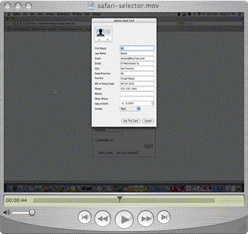
click to download movie One of the best moments of the DIDW show, for me, came when Ian Brown, an old friend of Chuck Mortimore, showed us his Identity Selector for Safari.

If you don't know Chuck, he single-handedly wrote a Java-based InfoCard Identity Selector that runs inside Firefox on almost any platform.  He gave me a copy, helped me install it on my computer, and it all just works.

Later I'll do a screen capture of Chuck's work since i can run it on my own machine. 

But I don't currently have a Mac – so Ian succumbed to my goading and put together a little video so you could see what he's working on.

That's such good news.  As he says, “For the faint of heart, or for those running those other operating systems, here's a short screencast of the Safari identity selector in action, authN'ing against Kim Cameron's RP…”

Meanwhile, here's what he says about the actual plugin:

This is currently still at the proof of concept stage, and is lacking most of the features found in the official CardSpace selector from Microsoft. At present, only a single self-asserted card can be selected. The “selector” will currently pull the logged in account's personal information from the AddressBook application, and allow you to use that AddressBook entry as a self-asserted InfoCard with various RPs. It should work with existing installs of Safari, and with most relying parties.

The plug-in itself is a wrapper around Chuck Mortimore‘s Java implementation of an InfoCard token generator. For those of you out there using Firefox, check out Chuck's cross-platform Firefox InfoCard selector.

So download the Safari Plug-In below and give it a spin. Send me any feedback at igb at hccp.org

I'll post new releases here as features are added and bugs are fixed.

Downloads

Currently there are two versions, one for the new Intel-based Apple's, and one for the PowerPC-based machiines. At some point I'll figure out how to get XCode to generate a Universal Binary. (I suppose the PowerPC build might work on the Intel Macs, that's what Rosetta is all about right? But it hasn't been tested on the Intel arch, so YMMV.)

Intel version
http://www.hccp.org/InfocardPlugin.bundle.zip
PowerPC version
http://www.hccp.org/InfocardPluginPPC.bundle.zip

Installation

Installation is pretty simple. After downloading the ZIP file, extract the archive. You should now have a file called InfocardPlugin.bundle. Just copy that to the Library/Internet Plug-Ins directory under your home directory. restart Safari, and off you go.

Despite Ian's self-depricating style I think what he and Chuck are doing is amazing.  And it shows what can and will be done.  Meanwhile, Apple People, download Ian's plugin and leave comments on my blog.

JP Rangaswami on how the OSP “feels”

A number of people have been writing good things about the Open Specification Promise.  The expression of good will speaks volumes about why I continue to love this milieu, and the people in it.

Your personal support in moving our work forward means a lot to Mike Jones and me.

I'm certain it will influence the way events unfold in the future.

Take a look at this piece by JP Rangaswami, author of Confused of Calcutta. I think he expresses what a lot of people are feeling. 

Ambrose Bierce, in The Devil’s Dictionary, defined a cynic as follows:

A blackguard whose faulty vision sees things as they are, not as they ought to be. Hence the custom among the Scythians of plucking out a cynic’s eyes to improve his vision.

Many years later, Albert Einstein defined common sense as “the collection of prejudices acquired by age eighteen”.

As I grow older, I realise that however hard I try to keep an open mind, and to learn, I land up with anchors and frames and perspective-biases that I don’t always know I have. Which means that sometimes I have to work hard to ensure that I don’t lapse insidiously into cynicism.

So you can understand why I had to work very hard indeed when analysing the Microsoft Open Specification Promise that was published yesterday. If you’re interested in the subject, then please do check out Kim Cameron’s blog hereDoc’s piece at IT Garage (where he asks for your opinion as well) and Phil Windley’s blog here, along with Becker and Norlin’s Digital ID World blog at ZDNet.

Microsoft are not known for their pioneering approaches in the opensource world. Identity is one of the three big issues that affects our ability to deliver the promise of today’s technology (the other two are Intellectual Property/Digital Rights and the “internet”, with or without Stevens’ Tubes). A valid solution for identity pretty much needs Microsoft’s support and that of its legions of lawyers.

And so we come to the Open Specification Promise. My early reactions? I think Kim Cameron and his team have done a brilliant job at pulling this off and getting something workable past the lawyers’ cynosure.

If you want to understand it, and don’t particularly feel like wading through “implication, exhaustion, estoppel or otherwise” (and who could blame you?), then skip the legalese and go straight to the Frequently Asked Questions section. I quote from the FAQs:

  • The Open Specification Promise is a simple and clear way to assure that the broadest audience of developers and customers working with commercial or open source software can implement specifications through a simplified method of sharing of technical assets, while recognizing the legitimacy of intellectual property.
  • We listened to feedback from community representatives who made positive comments regarding the acceptability of this approach.
  • Q: Why did Microsoft take this approach?
  • A: It was a simple, clear way, after looking at many different licensing approaches, to reassure a broad audience of developers and customers that the specification(s) could be used for free, easily, now and forever.
  • Q: How does the Open Specification Promise work? Do I have to do anything in order to get the benefit of this OSP?
  • A: No one needs to sign anything or even reference anything. Anyone is free to implement the specification(s), as they wish and do not need to make any mention of or reference to Microsoft. Anyone can use or implement these specification(s) with their technology, code, solution, etc. You must agree to the terms in order to benefit from the promise; however, you do not need to sign a license agreement, or otherwise communicate your agreement to Microsoft.
  • Q: What is covered and what is not covered by the Open Specification Promise?
  • A: The OSP covers each individual specification designated on the public list posted at http://www.microsoft.com/interop/osp/. The OSP applies to anyone who is building software and or hardware to implement one or more of those specification(s). You can choose to implement all or part of the specification(s). The OSP does not apply to any work that you do beyond the scope of the covered specification(s).

We have a long way to go before we can solve all this. We’re not going to solve all this unless we stop acting like cynics. So let’s get behind Kim Cameron on this and see what happens. That’s what I’m going to do.

An aside: Why can’t legal agreements be written like FAQ sections? Is there a law against it?

That's very generous, JP – although in fairness, I want to give the lawyers – from Microsoft as well as the open source world – full credit for getting behind this and making it real.

Friends, let's not stop until we get to the identity big bang.  Let's all keep our concentration.  Let's knock down the wall between us and the coming virtual reality.  Let's make it possible to know who we're dealing with on the Internet – when that is appropriate.  And let's do all this in a way that cradles our privacy.

Phil Windley at DIDW


Phil Windley at ZDNet has been blogging the DIDW conference, and captures a bit of it here:

This evening, at the reception for Digital ID World, someone asked me what I thought of the conference. I've been to every DIDW since it started (5 years now). I realized that the conversations and talks had changed from “won't it be cool when we…” to “this is what we did to…” That's a big change and shows just how far identity, as a concept separate from security, has come.

At the same time, I look around the show floor and other than the usual big names like Microsoft, Novell, and Oracle there are few repeat companies. Ping and a few others have been here from the start, but most seem to come and go. Part of that's because any company that gets successful gets bought by one of the big guys looking to build out their stack.

One of my favorite sessions today was Dave Nikolesjsin's presentation on citizen-centric identity. Nikolesjsin is the CIO for the Prov. of British Columbia. BC is making real progress building identity systems that have been proofed by in-person visits to government agencies. There are lots of lessons in what BC is doing–not just for other governments, but for any large organization.

The most significant announcement of DIDW was Microsoft's Open Specification Promise. For years, there's been an intellectual property cloud hanging over the OASIS specifications that form a large part of what makes Web services work. Unlike other standards bodies, OASIS doesn't require that technologies built into its specifications be IP-free.

Today's announcement is a huge step by one of the major contributors to the OASIS specifications. Microsoft irrevocably promises not to assert claims against people or companies who distribute products that conform to the specifications. Of course, like any legal agreement, there are terms and conditions. I'm sure some will be waiting to see what isn't there.

Since many of these specifications are at the heart of CardSpace, Microsoft's Internet-scale identity system, the announcement is especially important to other vendors working to interoperate with it. This is also important to Microsoft. If no one builds interoperable identity products for CardSpace, Microsoft will have failed to achieve true Internet-scale identity. Removing the legal threat is an important enabler.

More at Phil's blog here.

Microsoft's Open Specification Promise

Today marks a major milestone for Mike Jones and myself. 

Microsoft announced a new initiative that I hope goes a long way towards making life easier for all of us working together on identity cross-industry.

It's called the Open Specification Promise (OSP).  The goal was to find the simplest, clearest way of assuring that the broadest possible audience of developers could implement specifications without worrying about intellectual property issues – in other words a simplified method of sharing “technical assets”.  It's still a legal document, although a very simple one, so adjust your spectacles:

Microsoft Open Specification Promise

Microsoft irrevocably promises not to assert any Microsoft Necessary Claims against you for making, using, selling, offering for sale, importing or distributing any implementation to the extent it conforms to a Covered Specification (“Covered Implementation”), subject to the following.  This is a personal promise directly from Microsoft to you, and you acknowledge as a condition of benefiting from it that no Microsoft rights are received from suppliers, distributors, or otherwise in connection with this promise.  If you file, maintain or voluntarily participate in a patent infringement lawsuit against a Microsoft implementation of such Covered Specification, then this personal promise does not apply with respect to any Covered Implementation of the same Covered Specification made or used by you.  To clarify, “Microsoft Necessary Claims” are those claims of Microsoft-owned or Microsoft-controlled patents that are necessary to implement only the required portions of the Covered Specification that are described in detail and not merely referenced in such Specification.  “Covered Specifications” are listed below.

This promise is not an assurance either (i) that any of Microsoft’s issued patent claims covers a Covered Implementation or are enforceable or (ii) that a Covered Implementation would not infringe patents or other intellectual property rights of any third party.  No other rights except those expressly stated in this promise shall be deemed granted, waived or received by implication, exhaustion, estoppel, or otherwise.

Covered Specifications (the promise applies individually to each of these specifications)

Web Services  This promise applies to all existing versions of the following specifications.  Many of these specifications are currently undergoing further standardization in certain standards organizations.  To the extent that Microsoft is participating in those efforts, and this promise will apply to the specifications that result from those activities (as well as the existing versions).
WS-Addressing
WS-AtomicTransaction
WS-BusinessActivity    
WS-Coordination
WS-Discovery
WSDL
WSDL 1.1 Binding Extension for SOAP 1.2
WS-Enumeration
WS-Eventing
WS-Federation
WS-Federation Active Requestor Profile
WS-Federation Passive Requestor Profile
WS-Management
WS-Management Catalog    
WS-MetadataExchange    
WS-Policy
WS-PolicyAttachment
WS-ReliableMessaging    
WS-RM Policy
Remote Shell Web Services Protocol
WS-SecureConversation
WS-Security: Kerberos Binding
WS-Security: SOAP Message Security
WS-Security: UsernameToken Profile
WS-Security: X.509 Certificate Token Profile
WS-SecurityPolicy
SOAP
SOAP 1.1 Binding for MTOM 1.0    
SOAP MTOM / XOP
SOAP-over-UDP
WS-Transfer
WS-Trust
WS-I Basic Profile
Web Single Sign-On Interoperability Profile
Web Single Sign-On Metadata Exchange Protocol

Note that you don't have to “do anything” to benefit from the promise.  You don't need to sign a license or communicate anything to anyone.  Just implement.  Further, you don't need to mention or credit Microsoft.  And you don't need to worry about encumbering people who use or redistribute or elaborate on your code – they are covered by the same promise. 

The promise is the result of a lot of dialog between our lawyers and many others in the industry.  Sometimes we developers wished progress could have been faster, but these are really complicated issues.  How long does it take to write code?  As long as it takes.  And I think the same notion applies to negotiations of this kind – unless one party arrives at the table with some pre-determined and intransigent proposal.  People on all sides of this discussion had legitimate concerns, and eventually we worked out ways to mitigate those concerns.  I thank everyone for their contribution. 

How have people from various communities reacted to the final proposal?

Lawrence Rosen, the lecturer at Stanford and author of, “Open Source Licensing: Software Freedom and Intellectual Property Law”, said:

“I see Microsoft’s introduction of the OSP as a good step by Microsoft to further enable collaboration between software vendors and the open source community.  This OSP enables the open source community to implement these standard specifications without having to pay any royalties to Microsoft or sign a license agreement. I'm pleased that this OSP is compatible with free and open source licenses.” 

Mark Webbink, Deputy General Counsel at Red Hat, said:

“Red Hat believes that the text of the OSP gives sufficient flexibility to implement the listed specifications in software licensed under free and open source licenses.  We commend Microsoft’s efforts to reach out to representatives from the open source community and solicit their feedback on this text, and Microsoft's willingness to make modifications in response to our comments.”

And from RL “Bob” Morgan, Chair of the Middleware Architeture Committee for Education, and a major force behind Shibboleth:

The Microsoft Open Specification Promise is a very positive development.
In the university and open source communities, we need to know that we can implement specifications freely.  This promise will make it easier for us to implement Web Services protocols and information cards and for them to be used in our communities.

So there it is folks.  I'm impressed that such a short document embodies so much work and progress.

What you have versus what you are

 Ralf Bendrath sees biometrics as being about “what you have” (had?) rather than “what you are”.

Kim Cameron at Identityblog picked up on Jerry Fishenden's post on the problems of biometrics (by the way: Jerry will speak at our privacy workshop in Athens, see below). He again brings up the story from Malaysia, where some brutal car thieves cut off the index finger of a Mercedes owner in order to circumvent the biometric engine lock. First of all, the thieves could have had it much easier, also without having to carry around a rotting finger. With a bit more high-tech, in the future they could maybe just read the fingerprint out of the car owner's passport.

But more important, this case shows the problems with identity and how hard it is to proof to a machine who you are. It is often based on the classic trinity of authentication, which either can be done by something you have (a key, a USB dongle, a chipcard), something you know (a password, a PIN, your mother's maiden name), or something you are (your fingerprint, your retina). There are of course other possible authentication factors, but these are the most common.

This story makes clear that “what you have” is much clearer than “what you are”. I would prefer saying “I have ten fingers” instead of “I am ten fingers”. “What I am” relates more directly to my personality / identity than “what I have” or “what I know”. It is a story, a flowing amorphous thing, changing from context to context and over time. Of course, you can break it down to some extent to single pieces of data (address, date of birth, employer, email, favourite mp3s, …) – but this is all not good for authentication purposes, as most of it is not really secret. “What I know” can be secret, and as Jerry Fishenden points out in his post, could be linked to “what I have” in order to have multi-factor authentication. But it again is not the same as “what I am”.

Biometrics therefore is more about what I have than what I am. The only difference is that it can't be stolen as easily as a car key or a passport. Fingers can be cut off, but faces? Ok, Hollywood was always ahead of us.

Last open question: Can “what you have” also be said about the way you walk? Probably not. But is that really what you are?

Openssl vulnerability

Ben Laurie and Matasano Chargen describe a significant attack on RSA signature implementation (not the algorithm itself).  Quoting from Matasano:

Bell Labs crypto shaolin Daniel Bleichenbacher disclosed a freaky attack on RSA signature implementations that may, under some common circumstances, break SSL/TLS.

Do I have your attention? Good, because this involves PKCS padding, which is not exciting. Bear with me.

RSA signatures use a public signing keypair with a message digest (like SHA1) to stamp a document or protocol message. In RSA, signing and verification are analogs of decryption and encryption. To sign a message, you:

  1. Hash it
  2. Expand the (short) hash to the (long) size of the RSA modulus
  3. Convert that expansion to a number
  4. RSA decrypt the number
  5. Convert that to a series of bytes, which is your signature.

It’s step 2 we care about here. It’s called “padding”. You need it because RSA wants to encrypt or decrypt something that is the same size as the RSA key modulus.

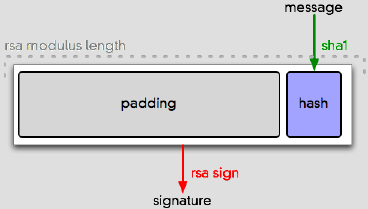
There are a bunch of different ways to pad data before operating on it, but the one everyone uses is called PKCS#1 v1.5 (technically, EMSA-PKCS1-V1_5-ENCODE). It involves tacking a bunch of data in front of your hash, enough to pad it out to the size of the modulus:

pkcs-s.png

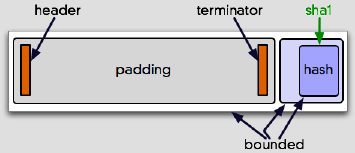
Note the order and placement of those boxes. They’re all variable length. Let’s call that out:

pkcs-b.png

The two big goals of a padding scheme are (a) expanding messages to the modulus length and (b) making it easy to correctly recover the message bytes later, regardless of what they are. This padding scheme is designed to make that straightforward. The padding bytes are clearly marked (“00 01”, which tells you that PKCS#1 v1.5 is in use), terminated (with a 00, which cannot occur in the padding), and followed by a blob of data with a length field. This whole bundle of data is what RSA works on.

The problem is, despite all the flexiblity PKCS#1 v1.5 gives you, nobody expects you to ever use any of it. In fact, a lot of software apparently depends on data being laid out basically like the picture above. But all the metadata in that message gives you other options. For instance:

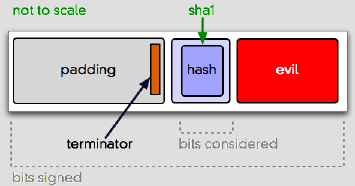
pkcs-a.png

For some RSA implementations, this could be an acceptable message layout. It’s semantically invalid, but can appear syntactically valid. And if you don’t completely unpack and check all the metadata in the signature, well, this can happen:

  1. Determine the padding from the fixed header bytes.
  2. Scan until the terminator.
  3. Scoop out the hash information.
  4. Use the hash to confirm you’re looking at the same message that the “signer” signed.
  5. Use the signature to confirm that a real “signer” signed it.

The problem is that this attack breaks the connection between (4) and (5). The hash, now “centered” instead of “right-justified”, doesn’t really mean anything, because the signature covers a bunch more bits.

This is all trivia without some value for “evil” that lets you substitute an arbitrary message hash (and thus an arbitrary message) into an otherwise valid-looking signature. Enter Bleichenbacher’s attack.

RSA takes parameters, one of which is a “public exponent”, which is part of the public key. If that exponent is “3”, which it often is, an attacker can exploit broken signature validation code to forge messages. The math here, which Bleichenbacher claims is simple enough to do with a pencil and paper, gets a bit hairy for me (I lose it at polynomials). Dino explains it better than I do. The long and the short of it is, you validate an RSA signature by computing:

s ^ e = m (mod n)

(where “e” is the public exponent, “n” is the public modulus, and “s” is the signature) and verifying that you get the same result as applying steps (1) and (2) from the signature process yourself. But:

  1. If the public exponent is “3”, and
  2. you inject the right “evil” bits into the PKCS data to make it a perfect cube, then
  3. you can create a something that broken RSA will validate.

Good technical details in Hal Finney’s OpenPGP post (OpenPGP is not vulnerable). And a security advisory for OpenSSL (OpenSSL is vulnerable, through 0.9.8b).

Two things have gone wrong here:

  1. Implementations misparse signatures, assuming that a syntactically valid-looking hash is semantically operative.
  2. For the common RSA exponent parameter “3”, there’s a straightforward way to manipulate a bogus signature to make it look valid.

My understanding is, the demonstrated attack sticks the evil bits outside of the DigestInfo (the hash data). The way I see the bug being described, broken implementations are just scanning the buffer without “fully decoding it”, implying that if they just validated the ASN.1 metadata against the signature buffer they’d be OK. That may be true, but it seems possible that a blind “memcmp” on an over-long SHA1 octet string, which would be ASN.1-valid and leave the Digest at the end of the buffer, could also trigger the same bug.

This is only a problem if:

  1. You’re running broken code
  2. You’re relying on certificate validation
  3. The certificates you’re validating use an exponent of “3”

Unfortunately, although the default for OpenSSL is “65537” (no practical attack known for that), “3” is common alternative: it’s faster, especially in embedded environments. Ferguson and Schneier recommend it in Practical Cryptography. Checking the CA bundle for “curl”:

cat curl-ca-bundle.crt | grep Exponent | grep “: 3” | wc -l

gives 6 hits, from Digital Signature Trust Co. and Entrust.net. Those same certs are in Firefox. Firefox doesn’t use OpenSSL; it uses NSS, and I don’t know if NSS is vulnerable. Here’s the code. I see it extracting a SHA1 hash’s worth of data, and don’t see it checking to make sure that date exhausts the buffer, but I don’t know the code well. Safari also depends on OpenSSL.

Correct me on any of these points and I’ll amend the post. I haven’t tested this (although Google Security did a proof of concept against OpenSSL that precipitated the advisory).

You should upgrade to the most recent OpenSSL. Bleichenbacher also recommended people stop using signing keys with a “3” exponent.