Why location services have to be done right…

uTest describes itself as the world's largest marketplace for software testing services. Recently it held a Bug Battle to test the web and mobile applications of the leading “check-in” location services. A Bug Battle is a quarterly app testing competition, where “software professionals from around the world compete to find bugs and rank today's popular applications” (previous Bug Battles have focused on browsers, search engines, social networking sites, etc.

When evaluating location-based check-in services, testers were given ten days in May to report the most interesting and severe bugs, and to rank these applications based on

  • geo-location accuracy,
  • social media integration,
  • friend connectivity,
  • status recognition features and
  • ease-of use

uTest offered nearly $4,000 in prize money to those who submitted the best bugs for feedback.
The results of the battle, which rated Foursquare, Gowalla and Brightkite, are detailed here.

The report includes comments by people who clearly love the service. For example:

“The Gowalla app and web interface themselves are easy on the eyes, and venues get their own snazzy icon depicting what type of establishment it is. I feed my Gowalla check-ins to Facebook, and having an image that catches attention in a cluttered news feed matters. The user can see everyone who has checked in at a particular venue and how many times.”
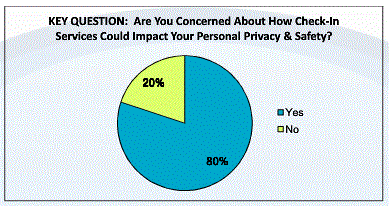
But one clear outcome is that many testers reported serious bugs related to privacy and security – a category not present in the original list:

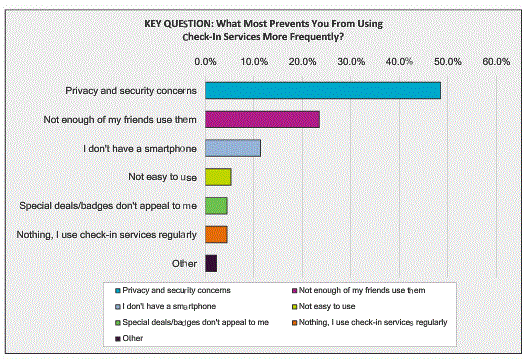
“The impact of check-in services on personal privacy and security took on a prominent role in this study. 80% of respondents responded “Yes” when asked if they were concerned about how location-based check-in services could impact their personal privacy and safety. Nearly half of respondents (49%) chose “privacy and security concerns” as the top reason they do not use check-in services more often.”
VentureBeat, which wrote about the report, concludes:

In addition to appreciating easy-to-use services and bemoaning the lack of Frappuccino deals, the testers seem to be concerned about the privacy and security implications of check-in services in general. 49% of testers said privacy and security concerns were the top reason they don’t use check-in services more often. This is something the check-in services need to address if they want to avoid privacy flames like the ones Facebook is constantly fighting.

These services can be built so as to respect and enhance privacy.  Things like giant world databases linking our devices to our home locations don't help convince anyone that we are doing that.

Claims based identity tops IT security concerns

John Fontana has crossed the floor, moving from the critics box to the stage.  

Many people will remember John's articles at Network World, where he served as one of the most talented and informed journalists in the world writing about network infrastructure for as long as I can remember. 

While it is sad to lose him in his role as journalist, I really look forward to what he will do at his new digs: Ping.  

I know his ability to explain identity and its issues and technology in words people can actually understand will benefit the whole identity ecosystem.  Kudos to Andre Durand and Ping for having the wisdom to bring him over.

Meanwhile, there's exciting news in this post from the new John: 

If I could say it better than my former Network World colleague Ellen Messmer I would, but I can’t so I’m just going to link to her story on Gartner’s survey that shows identity management projects rank first in the top five priorities for IT's security spending.
The results of the survey come from interviews with IT professionals at 308 companies.

But let me highlight two paragraphs from Ellen's story:

“Identity management appears to be taking the lead as a top priority as businesses look to deploy some of the more advanced federated identity technologies both within the enterprise for single sign-on and as a way to potentially extend identity-based access control into cloud-computing environments.”

And this one:

“But in terms of firewalls as a priority, [Gartner] notes that there's a movement to install next-generation firewalls.”

On that last point, check this link to From Firewall to IdentityWall.

[John is on Twitter where he also puts together a Tweet list]

Latitude privacy policy doesn't fess up to what Google stores

Never one to mince words, Jackson Shaw asks, “To the Google privacy core – Is it rotten?”  He writes,

“I read Kim’s post and immediately decided to turn off Google’s Latitude service on my phone but, as Kim illustrates, it probably won’t make any difference…

“I took a few minutes to check out Google’s privacy policy around Latitude and found out this much:

“If you choose to ‘Hide your location’, you can hide from your Latitude friends all at once, so they won't be able to see your location. If you hide in Latitude, we don't store your location.

“I’m not worried about hiding in Latitude. I wish I could hide from Google!”

The funny thing here is that Google already stores our residential locations through association with our devices, as indicated by its Gstumbler report, contradicting the Latitude privacy policy.

Jackson then directs us to a Wired article that is tremendously germane to this discussion – partly because of what it says about the current legal environment in the US, and partly because it reflects the very real problem that, in general, neither technologists nor policy makers understand that tapping of device identifiers is as serious as theft of content. 

See:  “Former Prosecutor: Google Wi-Fi Snafu ‘Likely’ Illegal ” – I'll discuss it next.